Urge and Aoibheann reveal some of Deus' past; Devon and Deus discuss the future; Urge meets a familiar face on Earth.
Showing posts with label Urban Numina. Show all posts
Showing posts with label Urban Numina. Show all posts
Monday, July 4, 2011

Episode Five: Urge
Urge appears on the mortal realm; Deus has a surprise for Devon; Andrea Carey and Mel try to work out what is going on.
Tuesday, June 14, 2011
Episode Four: Andrea
Two mysterious strangers, Devon faces off against Mel, Carey comes bearing news about Deus.
Another fun episode of Urban Numina, and the first with our new camera.
Conan
Monday, May 16, 2011
Behind the Scenes: Episode One
It is always with a mix of excitement and dread that I release a creative endeavour out into the wild frontier of the public. You always have to steel yourself for the inevitable mix of praise and criticism that strikes.
But it is done. The first episode is completed and out there for everyone to see, and I'm now in the process of working on the second episode edit.
As outlined at the beginning of this ambitious project, we are literally shooting an episode and releasing it a week after shooting - this is a crazy schedule to follow, and it will get easier next month when I shoot two episodes a weekend rather than one. (Basically we will shoot two weekends a month, which should provide 4 episodes worth of footage.)
It's a testament to the cast's eagerness that they have opted to add another weekend this month to their schedule to shoot a bonus episode - one that I am working on at the moment while also laying the foundations for episodes 8 - 13.
Hopefully by episode 8 we'll still have the same enthusiasm and vigour that has characterised the first two shoots. :)
But today I am going to talk a little more about Episode one.
We shot the entire episode on Saturday 7th May. Due to the nature of the project, we had cast and crew sharing duties all day. Josh, whose eager energy and positive energy certainly has been helping keep everyone else upbeat, showed up about ten minutes early and was all set to start shooting as soon as possible.
The original script had Andrea and Mel arguing on the balcony so that I could take advantage of the fantastic view from there - on a sunny day it is a stunning view of Wellington Harbour. Unfortunately Mother Nature had other plans.
I had spent the week planning out an alternative version of the scene set within the lounge, and so we were able to still shoot without too much fuss.
Within a very short period of time we had all the cast for the first scene on set, and were missing a cameraman. My plan was to shoot with two cameras to help reduce shooting time - ideally you want to capture as much footage as you can to give the editor plenty of material to play with during post. So Lee, who plays Carey, stepped up to the mark to handle the second camera while I managed first - and Michael (Deus) took over boom duties during the first scene.
We shot several takes, mostly because Jenni, Josh and Kerina were so excited to be shooting they kept breaking out into giggles.
Then it was Mike's turn to shuck off his clothes and pretend to be a naked deity. For the record - and for those who have seen Josh's blooper reel - Mike was not naked. But he certainly was a real trooper who willingly stepped out into the blustery, cold and wet balcony to give himself a genuine sweaty appearance for his "emerging from the vase" shot. I think it is a testament to his professionalism that he not only had fun, but dove in without any complaints. Even when I had him standing, legs spread while I tried to frame one of my favourite shots from episode one of the three flatmates looking at him. It was certainly awkward in the tight confines of the kitchen.
We initially started an hour later than planned, but due to the use of the flip minos, there was no need for elaborate lighting rigs, which meant that moving from shot to shot and scene to scene was a painless and fast process. Normally you would need to break down the lighting and rejig it for the next shot. The down side is that we did get some odd lighting quirks that required colour correction in post. In episode two I decided to try natural lighting and nothing else, and that seemed to produce a better result overall. But still not perfect. Unfortunately, as my favourite saying this project has become, that's the nature of the beast we have taken on here.
Unfortunately when we changed boom operators for the next scene, someone accidentally turned off the boom. This wasn't noticed during the shoot, and as a result it made the boom material we did record useless because the sound inconsistency would have been too jarring. As a result, I was forced to use the Flip mino audio recording. Forunately, the minos do a great job of picking up voices and through some careful work within iMovie 11 and a great little program called Audacity we were able to mitigate most of the background hiss and sound issues. It isn't as good as a boom, but a great way to recover from such a nightmare situation.
Normally when shooting outside in a public location, you need to arrange releases through the city council - mainly because you are potentially making a hindrance and nuisance for other people who may wish to use public resources. Due to our cast and crew literally being 5 people with a camera the size of a mobile phone, I figured we could get away with being more guerilla film crew about it and just shoot as long as we kept out of people's way. I have to strongly state - if you are planning on using white boards, lighting or anything more elaborate than the size of a mobile phone for your shoot - GET APPROVALS.
The same goes for if you plan to do anything that involves guns, fighting or in some way could lead to someone in the public thinking there is a threat. Otherwise you can expect the police to show up. It is often also a good idea to call the police even after getting council approval - because, again, this just keeps the people who need to be in the know... well... in the know.
Fortunately we had nothing like that planned - and with the weather clearing up enough we were able to shoot Melissa (Ziana) and Andrew's (Urge) scene without drama or interruption.
So with the episodes being released essentially on a weekly basis, this is a great opportunity to discuss with me the series and your thoughts. Let me know who your favourite characters are. Tell us about your favourite cast members and what you think of the various storylines. I'm particularly interested in hearing about thoughts people have in regards to what is going on and who really is intending to do what. I know what is going to happen, but I'm also interested in hearing people's opinions.
The same goes for the humour. More? Less? This is your chance to talk directly with the guy who makes the big decisions about the direction Urban Numina heads.
Look forward to hearing back from your all!
Conan
Sunday, May 15, 2011
Urban Numina Episode One: Deus
Flatmates Andrea, Devon and Mel find themselves with an unexpected new flatmate after Devon accidentally breaks a vase from under the house and appears to release God. Or maybe things are not all as they seem...
It's here - the first episode of Urban Numina! Enjoy!
Conan
Thursday, May 12, 2011
The Countdown Begins
As those who follow my twitter feed know, I have been battling to edit the first episode and have been trying all manner of tricks and techniques.
With the final edit almost ready, I had some time today to play around with teaser trailers - give audiences something to look at prior to the main event.
The first trailer is the "official" teaser - it is straight forward and hints at events in episode one. The second is a fun little trailer I made using iMovie 11's trailer templates. It doesn't really make a lot of sense, but it is kind of fun.
Keep watching folks! We're almost ready to start the ball rolling. :)
With the final edit almost ready, I had some time today to play around with teaser trailers - give audiences something to look at prior to the main event.
The first trailer is the "official" teaser - it is straight forward and hints at events in episode one. The second is a fun little trailer I made using iMovie 11's trailer templates. It doesn't really make a lot of sense, but it is kind of fun.
Keep watching folks! We're almost ready to start the ball rolling. :)
Saturday, May 7, 2011
What's this?

Ziana (Melissa Phillips) and Urge (Andrew Goddard) are waiting to reveal that episode one has been all shot and is now being edited! :)
Conan
Thursday, May 5, 2011
Multimedia: New Ways to Tell Your Story
I know I said I'd be covering the rehearsals more, but I'm really keen to explain and expand on what is happening via Twitter and Facebook for Urban Numina.
One of the key things about distributing a series via the Internet is that you get to play with how you tell your story. Engage the audience via multiple sources for information about the show and it's characters.
What I have started with Urban Numina is a kind of prologue story told via the tweets of Jenna, Devon, Andrea and Mel. The trick is for followers of these twitter feeds to piece together what is happening via the comments being made by the characters. This is also a chance to learn more about the characters via their comments. Much in the way that the UK series Misfits did.
Secondly, there will be photo essays and other "in world" material posted on our upcoming facebook page.
The idea here is to have multiple leads into the show, and make a bit of a game out of following the various sources.
Nothing vital will be presented via these extra media resources, rather I am using them to help flesh out the world and its characters.
But this kind of thing is only as effective as the social networks they are a part of. This is where you come in. Spread word and get people following the characters. The more people engage with the twitter feeds, the more they will become a part of the series and the more interesting the storylines will become. :)
So spread the word folks!
Mel - @Mel2theR
Jenna - @ForevaJenna
Devon - @TheSharpeD
Andrea - @WgtnAndrea
Catch you later folks!
Conan
One of the key things about distributing a series via the Internet is that you get to play with how you tell your story. Engage the audience via multiple sources for information about the show and it's characters.
What I have started with Urban Numina is a kind of prologue story told via the tweets of Jenna, Devon, Andrea and Mel. The trick is for followers of these twitter feeds to piece together what is happening via the comments being made by the characters. This is also a chance to learn more about the characters via their comments. Much in the way that the UK series Misfits did.
Secondly, there will be photo essays and other "in world" material posted on our upcoming facebook page.
The idea here is to have multiple leads into the show, and make a bit of a game out of following the various sources.
Nothing vital will be presented via these extra media resources, rather I am using them to help flesh out the world and its characters.
But this kind of thing is only as effective as the social networks they are a part of. This is where you come in. Spread word and get people following the characters. The more people engage with the twitter feeds, the more they will become a part of the series and the more interesting the storylines will become. :)
So spread the word folks!
Mel - @Mel2theR
Jenna - @ForevaJenna
Devon - @TheSharpeD
Andrea - @WgtnAndrea
Catch you later folks!
Conan
Wednesday, April 27, 2011
Planning: Call Sheets and Storyboards
Now that the days have been scheduled, location selected and cast chosen - it's time to put together call sheets for the days of the shoot. There are plenty of call sheet templates out there - but here is an example of an Urban Numina Call Sheet.
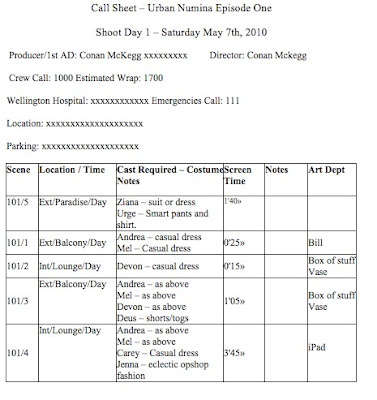


Generally you will have two such schedules. This is for cast and crew outlining the overall plan for the day. It outlines the order that scenes are planned to be shot in, when people are expected to show up and when they are expecting to wrap for the day.
It is important to note that you can rarely set a solid wrap time because shoots can run overtime or finish early. It is best to set your wrap time later than you intend to wrap because it will give you some breathing space in the event of the shoot running over time, and it also is a boost for cast and crew if you manage to finish early.
A good call sheet will allow you to break down your script, work out the order in which to shoot scenes and save you a lot of time planning and organising. It is really important to plan efficiently so as to not have actors sitting around half the day with nothing to do. Call sheets will help you plan out when the actors are required. An average day should net you 5-10 minutes of usable footage if you have an experienced cast and crew. 3-5 minutes if inexperienced. So roughly plan to shoot an hour per minute of footage you want to capture.
How did I work out the length of each scene. The standard belief in Hollywood these days is that a page of a script roughly translates to a minute of screen time. So you will need to make an estimate. If the scene takes up approximate a third of the page, it is likely to be about twenty seconds of screen time. There are always exceptions, but at the planning stage this tends to be a safe estimate to work with. Note that with much more dialogue driven scripts, scenes can end up running shorter or longer than they seem - based on performance and direction. But you generally will find the a page per minute ratio a good measure to work with.
The second schedule is a shots sheet. I haven't done one for Urban Numina mostly because they are very time consuming. A shot sheet resembles a call sheet but it is split up over each shot that you are planning to take. This is actually important, but I have included the shots in the storyboards, so I will be working straight off those. Because each episode is fairly short and low on complex visual effects, I can afford to do this. If you are planning to do anything that involves a lot of complex photography, FX or movement, a shot sheet is going to make your life a lot easier.

Above is an example of the storyboard for the opening scene of Urban Numina. This was created using Cinemek Storyboard on the iPhone. A word of caution, a small 7 minute storyboard takes a long time to render and upload as an e-mail. Be prepared to wait. Still the finished storyboard is great and comes in PDF format - which you can then load on a tablet like an iPad and have with you during your shoot. Because the storyboard allows me to split scenes down shot by shot, I can use it instead of a shot sheet. Normally storyboards are too big to have on set, so you go by a shot sheet instead.
Celtx also has a great tool for breaking down shots and preparing a shot sheet for you and is well worth the investigation.
Good planning does wonders for a project. It keeps morale up, because it convinces cast and crew that things are organised and will see completion. It helps reduce the downtime for people on set - actors love to act and hate sitting around waiting for their next scene. Keeping a good plan and schedule ensures you don't waste their time and they leave a shoot feeling positive and that they have done a good day's work. Actors who had to sit around all day long doing nothing tend to walk away feeling that their time was wasted and nobody knew what was going on.
Be prepared for plans to go awry - I often prepare notes for extra scenes in the event that suddenly we have to change shooting order etc. But if you have done your job right, your shoot should run relatively smoothly and be full of positive and excited people eager to see the project to completion.
Next: Rehearsals, and spreading word about the project...
Conan
Tuesday, April 26, 2011
Scheduling: Herding Cats and Learning Patience
When you are producing a web series, it is going to be vital to get your scheduling down tightly.
Actors, crew, locations, friends and family - there are a lot of factors that you need to balance to make your production a success. My most vital piece of advice is don't give up.
There will be times where you will get frustrated - the larger your cast the more difficult it is going to be to organise. Organising all these elements can feel like herding cats. You need to be able to balance peoples' commitments with the commitment to the production.
While it would be nice to hope that everyone will make your project the first commitment for them, it's not a reasonable hope. Cast and crew are likely to be providing their skills and expertise on a volunteer basis, and they will only have so much time available for doing volunteer projects. They still need to eat, and get paid.
So the trick is to keep open about scheduling with everyone involved. Engage them in the process so that they feel that they are having a say. You will find that people are willing to make compromises if they feel that they are being listened to.
In most cases you will be able to make things work, but you need to be patient and be able to change plans.
In the case of Urban Numina, I had placed some very tight turn arounds on the cast and crew. I wanted to get into shooting as soon as possible. Locking down a location was proving to be difficult and to use the house I wanted to, I needed to be able to provide dates and times so that the occupants could plan around my timetable.
As such, I had a very tight set of dates available. This was further complicated by the fact that The 48 Hours Film Challenge was sitting right in the middle of May - which many of our team are involved in. Then I discovered one of the cast was involved in a theatrical production that had booked out all Sundays with rehearsals - which made my range of options even smaller.
I didn't want to shoot every weekend of the month, and with 48 hours I expected people to be exhausted for the next week and a bit.
To further complicate things, another actor had family commitments on the weekends I did have available!
So what was a producer to do? Give up? Never! Delay until June? I wanted to strike while the cast were still eager and positive about the production. The longer it takes until shooting, the more time for that good will to weaken.
The solution ended up being an easy one. I split the episodes up into six shorter pieces, (although in total they actually add about 6-10 minutes of extra film time to the original three) and split these around the times certain actors were free and when locations were available.
This succeeded in doing two things for me - firstly, I was now able to shoot a single episode in a day rather than needing 2-3. Secondly, it allowed me to shoot around other people's commitments and keep their on set time down to around 4 hours each in most instances.
Ultimately we can shoot the episodes and start releasing them at the end of May while still getting a 2-3 week break between episodes 2 and 3.
What happens if nobody is free at the same time? This is an unlikely situation, but it is possible. Some people do audition despite not actually having the time to do the project if they are successful. In the unlikely event of this occurring, it will depend on the people involved. You will likely need to get hard with some of the actors. Stick the the largest number of actors able to work at the same times and recast the rest if they cannot reschedule.
I don't think it is really that likely though, so you should be fine.
So remember, be flexible and patient. Sometimes it looks like you have no options, but if you take a deep breath - walk away from schedules for a day or two and then come back and look at them again, you will find a way around. And by being open to the cast and crew, I had some of them come back and offer suggestions of what days worked for them.
Keep honest, keep positive and keep determined. Scheduling will prove to be one of the biggest challenges you'll face - but it is also one that can be overcome.
Next - Making a call sheet.
Conan
Monday, April 25, 2011
Auditions Part 3: The Ladies - Second Half
Apologies again for the delay in updating the blog. I have been very busy negotiating locations, doing one final casting that has now turned into two new roles, and scheduling the series along with a major adjustment to the scripts.
More on that later. :)
Here are the remaining auditions.
Melissa
Olga
Rebecca
Zelda
After going through all the auditions, Kerina and I agreed to call back Melissa and Ella to audition for the role of Jenna.
Melissa's Jenna Audition
Ella's Jenna Audition
As you can see, two very strong performances, which made the casting somewhat difficult. In the end, after much careful consideration, the casting ended up as follows. Note that some roles had already been cast to people I knew were best for the parts.
Andrea - Kerina Deas
Anima - Rebecca Parker
Carey - Lee Dowsett
Deus - Michael Van Echten
Devon - Joshua Stewart
Jenna - Ella Hope-Higgson
Mel - Jenni Dowsett
Urge - Andrew Goddard
Ziana - Melissa Phillips
Oooooh - who is Ziana, you ask? Well you'll just have to wait and see. I'll discuss the character in more depth later.
Next up: Schedules and Call Sheets
Conan
Tuesday, April 19, 2011
Auditions Part 3: The Ladies - first half
Now for the ladies. Of course we had a larger number of women audition for the role of Anima. Without further ado, here are the first five.
Ange
Anita
Ella
Emma
Gina
As you can see, Anima's role is a much more serious character.
I'll be uploading more auditions tomorrow.
Conan
Friday, April 15, 2011
Auditions Part 2: The Boys
As promised here are the male auditions for the series.
Unfortunately Dan pulled out of the running as he is now moving to Australia, but I felt you still needed to see his audition because he is very talented.
Without further ado, here are the auditions.
Andrew
Dan
Josh
Kieran
Michael
Next up - the ladies!
Conan
Thursday, April 14, 2011
Auditions Part 1: Casting Completed!
Inkeetoe? Insightoe? Deuce? Dayoos?
Auditions and casting is now effectively over. We have seen a number of people, had a few debates over pronunciation and discussions between myself and Kerina - who is playing Andrea - as to who should be in what part. But it is now all done.
Over the next few days I shall be showing some of the auditions we had to give you an idea of breadth of talent and interpretations we saw.
It is very satisfying to know that there is so much talent out there, but kind of upsetting too - because I can't cast everyone, as much as I might like to. It's also a little frustrating because it makes the decision making process that much harder when you simply can't decided out of three or four incredible performances.
Some helpful pointers though:
- When running an audition, I find it is best to get at least three takes from an actor. One is a cold read where you get to see their own take on the role, one is with direction and the third is if they want to give it one more go. The reason I like to do this is because I know what it is like to walk out of an audition and think "if I had only done one more take..." So I like to try and let the actors get one more take before we finish up their audition.
- Let the actors ask questions before starting. A side rarely tells the actor the full story about their character. Giving them a chance to ask a few questions about the project and the character helps them to get them focused on what is expected. It also lets you as a producer/director get a feel for the actor as a person. When you are working with people on a volunteer project, it is good to know if their dynamic is going to match the other cast and crew.
- Be friendly. Auditions are scary things to do, it's a competition and most actors are nervous - even the real professionals still have butterflies - so keeping a friendly and approachable demeanour means that they are more likely to listen to direction and open up for their audition.
- Try to have someone else with you. Due to timing issues, some of the auditions were just myself and the actor. I don't usually like doing this as it can feel a little confrontational or creepy. Especially if you are holding auditions in a house rather than at a studio. Having another cast or crew member with you helps to add a sense of legitimacy to your project.
Something I noticed locally here is that there are a lot of actresses and simply not enough roles to go around. I definitely intend to write a female heavy project for my next undertaking...
When it came to making the decision of who got which part, we had some interesting situations. Two of the roles were no brainers. Kerina and I both just looked at the video for the two actors and said straight away yes. There simply was not doubt that they nailed their characters in ways that the other actors simply didn't.
However, two roles were very hard to decide on. The male role had two contenders. One who looked like the classical idea of the role and played the part well, and the other who had a more unusual look but had a very intense focus. The part of Anima was also hotly contested, and came down to three very different takes on the character - over which Kerina and I had much debate. The actresses were three very different looks for the part and had three very different ways of playing her.
When I put the auditions up, I won't actually discuss each individual actor and why they did nor didn't get the role. Mostly because I don't feel that it would be fair. I will cover here the key things that it came down to for each role without discussing the aspects of the actors who got the parts - these are just notes about what Kerina and I ended up agreeing were the key points we were looking for.
Devon: Despite being a mortal character, Devon is one of the most comedic characters in the script. He does a lot of physical and expressive comedy, and as such needed a very animated actor who could do funny facial expressions while also still looking cute in a boy-next-door kind of way.
Deus: On the shallow end, Deus needed to be attractive. But he also needed to be distinctive. When the actor walked into frame, he needed to have a presence that commanded attention. He also needed to be able to be both neutral but warm and be able to play opposite Devon.
Urge: In many ways Urge's character is fairly easy to play. He's larger than life and often just needs to be a little slutty in his acting. What we were looking for is an actor who could build on that and give Urge more comedy out of his performance than just relying on his audacious dialogue.
Anima: Anima was a very hard role to nail. I had very specific ideas about who she was, and the actress really needed to have a strong presence as well as a mystery to her. The role was one that needed both a warmth and a sharp edge hidden within it. As Kerina likes to say "there is a sense of 'don't f**k with me' to her."
Sadly, not everyone could "win" and I have had the unenviable job of telling most of the people I saw that they didn't get a part. Which I hate doing, because it wasn't a case of them not being good, but that there were a lot of good people who auditioned. It was not an easy decision.
Fortunately, I now know who is out there looking for work and can write characters with an idea of the people I'd like to ask to play the roles. So hopefully in the future we will see some of these faces in the series at a later point. (Fingers crossed.)
So tomorrow I shall start off with the boys - make sure to be here not only to see the auditions, but hear some of the script.
It's going to be an interesting exercise!
Conan
Sunday, April 3, 2011
Casting: Putting out a casting call
With the first drafts of the series now completed, it's now that things get complex. Making a web series is not about one step after the other - eventually a producer, much like a professional juggler, has to start throwing more than one ball up into the air.
Once you have your scripts ready, you need to begin planning *how* you intend to shoot your series and also start gathering your cast.
Fortunately, I already have three roles effectively cast. Mel, Andrea and Carey. I'll still be asking the actors to do a screen test of the character so that I can get a feel for how they intend to play their character, but the roles were effectively written for these three.
But I still have four roles to fill, and they are all central roles to the show. The plan here will be to put out casting calls, hold auditions and once I have my full cast we will be doing workshops to improve the comedy of the script to match the actors.
But how do you put together a casting call? First, find somewhere that will allow you to post them. There are a lot of great sites these days for putting up casting calls.
These are two New Zealand based sites that I have chosen to advertise on.
A more international service for small productions is Spidvid but I have very limited knowledge about it's effectiveness. Do a google search, and ask around local theatre groups. Ideally, the more places you put your call up, the more responses you are likely to get.
But how do you put together a casting call?
Keep It Brief
There is a temptation to go into great detail when putting up a casting call. What you need to do is give actors enough information to pique their interest and get a feel for the character, but not so much as to lock them into a performance that will feel unnatural to them.
Most of my advice focuses around this. Do not make the mistake of trying to mould the actor into the role. The trick is to find the point where the actor's interpretation and your vision come together to create a living character. In order to do this, you need to give the actors enough freedom to interpret the role and enough direction to know where they need to be focusing.
I tend to pick key words that define the core of the character and a few lines about how I see that character being played. Beyond that, it's too much at this early stage. Part of the process is developing the character with the actor rather than just saying "your character must be played like this..."
Be clear about expectations
As you will note in the ads, I'm upfront about Devon and Deus being shirtless. The opening scene of the series has Deus showing up naked, and actors need to know when that is expected. Now my plan is to shoot the scene so that the nudity is implied rather than shown - so the actor will be wearing shorts and we'll be shooting only above the waist and a shot of his legs - but no actual nudity.
However, this does need to be known. Also, I have tried to be clear that this is a comedic show and actors will need to have some comedic timing. This isn't so central, as we can build on timing issues - but again, it helps to give them an idea as to what tone is going to be expected when they audition.
Don't be too limiting
Now despite all that, I need to stress that you can't be too limiting in a casting call. I generally avoid mentioning ethnicity or body type because I like to see who shows up and what kind of performance they bring with them. Deus could be muscular, athletic, slim, European, Samoan, Chinese...
You do need some limitations - Deus and Urge need to be physically fit and attractive - and if this was a story about a Danish family, obviously I would be looking for people who can look and act as if they were Danish. But in regards to these characters, I'm wanting to keep things open. I'm wanting to be surprised by the people who apply, and give them an opportunity to show me their take on these characters. Because there will be improv and workshop sessions to develop the characters further, I need to be seeing people who can show creativity and initiative in their roles but who can still take direction.
So now it is simply a matter of waiting for the applications to come in.
Next: Auditions
Conan
Tuesday, March 29, 2011
Music: GarageBand Versus Real Bands
Producing a series requires you to wear a lot of hats, especially if you are intending to also write and direct the show too. (I once tried the acting deal too - it was a lot to deal with.)
The point I'm getting to is that while I have been writing the series I've also been planning the casting and music for it too. Which brings me to the point of this post. Music.
The worst mistake a producer of a webseries can make is leaving music until last thing. Music can make or break a series. If it is too amateur and clearly peddled together last minute it can make the best performance and editing still look rough and cheap. If the music is polished and evocative, it can raise the appearance of a bad production to looking more deliberate.
Now the usual assumption is that you can pile together a flash piece on GarageBand with a few loops. While there is a degree of truth to this, everyone knows those loops. Without some musical embellishment it can make your show look lazy - and nothing is more embarrassing than later finding out that your loop theme is the same as one in some obscure internet porn movie!
At the very least it pays to have a musician/composer work on GarageBand for you to make sure that you get a fresh sound.
Alternatively, there are Royalty Free sites all over the place that produce passable music you can use. But you often run into the problem that barring some stings and short bars, most of the music is either bland or lacks suitable audio cues.
I, personally, have found a lot of royalty free music to lack a certain "fullness" and usually sounds cheap and nasty.
MingleMedia made a great suggestion once, get a real band. Most towns will have a couple of talented independent bands and singer/songwriters just dying for exposure and who will have music recordings they are happy to give you permission to use if you link back to their myspace/facebook pages.
The benefit of using actual songs is that you don't need audio cues, you can usually find songs to suit most moods and it gives the show a more polished feel as most of these guys are talented at making real music regardless of whether it is via synth, GarageBand or an actual four piece group.
I also feel that it works with the village economy state of independent web productions. They provide music, you help with increasing their fan base.
Currently I have been working with two groups who have shown interest in being involved with Urban Numina.
http://www.throwittothefire.co.nz
A local rock band whose track "PS" is sounding suitable for a scene with Urge and Mel. I'm looking to go over their tracks as we shoot the series to find where they will fit.
http://www.jezkemp.co.uk
Although Jez's site is a uk one, he is based here in Wellington. A lot of his music is ideal for the show and I already have one of his songs in mind for the main theme for the show.
For those of you looking for bands, My Space is a good place to start. But also try to make contact with people into the local music scene - as they can introduce you to a number of these bands.
Next: Preparing for Casting!
Conan
The point I'm getting to is that while I have been writing the series I've also been planning the casting and music for it too. Which brings me to the point of this post. Music.
The worst mistake a producer of a webseries can make is leaving music until last thing. Music can make or break a series. If it is too amateur and clearly peddled together last minute it can make the best performance and editing still look rough and cheap. If the music is polished and evocative, it can raise the appearance of a bad production to looking more deliberate.
Now the usual assumption is that you can pile together a flash piece on GarageBand with a few loops. While there is a degree of truth to this, everyone knows those loops. Without some musical embellishment it can make your show look lazy - and nothing is more embarrassing than later finding out that your loop theme is the same as one in some obscure internet porn movie!
At the very least it pays to have a musician/composer work on GarageBand for you to make sure that you get a fresh sound.
Alternatively, there are Royalty Free sites all over the place that produce passable music you can use. But you often run into the problem that barring some stings and short bars, most of the music is either bland or lacks suitable audio cues.
I, personally, have found a lot of royalty free music to lack a certain "fullness" and usually sounds cheap and nasty.
MingleMedia made a great suggestion once, get a real band. Most towns will have a couple of talented independent bands and singer/songwriters just dying for exposure and who will have music recordings they are happy to give you permission to use if you link back to their myspace/facebook pages.
The benefit of using actual songs is that you don't need audio cues, you can usually find songs to suit most moods and it gives the show a more polished feel as most of these guys are talented at making real music regardless of whether it is via synth, GarageBand or an actual four piece group.
I also feel that it works with the village economy state of independent web productions. They provide music, you help with increasing their fan base.
Currently I have been working with two groups who have shown interest in being involved with Urban Numina.
http://www.throwittothefire.co.nz
A local rock band whose track "PS" is sounding suitable for a scene with Urge and Mel. I'm looking to go over their tracks as we shoot the series to find where they will fit.
http://www.jezkemp.co.uk
Although Jez's site is a uk one, he is based here in Wellington. A lot of his music is ideal for the show and I already have one of his songs in mind for the main theme for the show.
For those of you looking for bands, My Space is a good place to start. But also try to make contact with people into the local music scene - as they can introduce you to a number of these bands.
Next: Preparing for Casting!
Conan
Scripting Part 2: First Drafts and Writer's Block
I have almost finished the first drafts of the series. It was a pretty challenging undertaking as I had to spend some time working out the "voices" for each character.
Once episode one was completed, I sent copies to my brother and some of the people I have in mind for certain roles in the show - to get their feedback. Having been suffering from a degree of Writer's block, it was a challenge getting that first script written. But the best solution to writer's block still is writing. Just anything to clear the mind.
Feedback has been good, although it is clear that the script is still a bit wordy at the moment. I've received some excellent feedback regarding the characters and we're well on our way.
The next step, once I complete episode 3, is to cast the characters and run a character workshop where we will focus more on the comedy aspects of the script.
I find comedy to be heavily reliant on a combination of writing and casting. The best solution is to find people who are capable of being comedic and then build the humor around their strengths.
When I get to casting, I'll be posting the auditions up on the site for you all to see and comment on. :)
Stick with me here. Things are picking up pace!
Conan
Once episode one was completed, I sent copies to my brother and some of the people I have in mind for certain roles in the show - to get their feedback. Having been suffering from a degree of Writer's block, it was a challenge getting that first script written. But the best solution to writer's block still is writing. Just anything to clear the mind.
Feedback has been good, although it is clear that the script is still a bit wordy at the moment. I've received some excellent feedback regarding the characters and we're well on our way.
The next step, once I complete episode 3, is to cast the characters and run a character workshop where we will focus more on the comedy aspects of the script.
I find comedy to be heavily reliant on a combination of writing and casting. The best solution is to find people who are capable of being comedic and then build the humor around their strengths.
When I get to casting, I'll be posting the auditions up on the site for you all to see and comment on. :)
Stick with me here. Things are picking up pace!
Conan
Monday, March 7, 2011
Scripting Part 1: Treatment to Script
I spent this weekend and this morning working on the treatments for Urban Numina, and as predicted there were some interesting changes.
One of the key ones is that I'm inclined to drop the first season down to three episodes. The reason being is that the treatment for episode three feels like a really good cliffhanger ending. Anima shows up, Devon and Deus' burgeoning relationship looks to be over before it began, Mel and Urge hook up and Andrena thinks she's close to exposing the Numina's motives.
This feels like a great point to leave off and get the fans begging for more. I'm holding off on episode four now just to see how the first three scripts develop.
Another interesting development from the treatments is the creation of a seventh character - Carey. This character had been in the back of my mind when I was initially conceiving the show. He's a nice everyday guy, a researcher of some kind, who has an on again, off again relationship with Andrena. I found that he kind of worked his way into the story as I wrote it, being the guy that Andrena can turn to because Mel and Devon are too wrapped up in the Numina.
In a way he's the compass for Andrena and the others. When they overlook something obvious, he guides them to look at it. He spots the things that they ignore and he plays a bit more of a sceptic role. He challenges the Numina to prove they are supernatural and he suspects certain things about Deus and Urge's relationship to each other.
So now it is time to start writing scripts. I'm happy with the treatments and the outline they have given me. The first few episodes are strong, in my opinion, and have suitable structure.
But what do I need to know before I start writing a script?
Two excellent resources I'd recommend are The Guerilla Filmmaker's Handbook by Chris Jones and Genevieve Jolliffe; and The Complete Idiot's Guide to Screenwriting by Skip Press.
Both of these books provide invaluable advice regarding scripts. There are certain conventions and format rules that are used in the professional industry - and it is well worth learning these conventions. It is also worth noting that film and television do have slightly different rules - but these can be overlooked.
Now obviously you don't want to be pissing around with too much formatting while you are writing. There are two ways to tackle this. One is to just write normally and apply formatting afterwards. I personally find this a bothersome method and a poorly advised process to follow. I would not recommend it and I would question the wisdom of anyone who did especially when there are so many excellent programs out that for screenwriting that do all the work for you and let you just get straight into writing.
The best, I feel, is Celtx, which is not only an industry standard application, but also a free one. You can also buy a support application for iPad and iPhone that allows you to write on these devices and sync the scripts up on a server to download to your computer - which means you can take your scripts anywhere and update them on the fly. Very useful when making changes mid shoot or when you suddenly are inspired regarding a scene while out and about.
Some professionals will pooh pooh the idea of trying to write a script on their iPhone, but I managed to write 70 pages of my revised Winding City script in exactly this way during lunch breaks. The Celtx app is extremely intuitive and easy to use. I find it makes writing anywhere hugely easy and removes one of the greatest obstacles of writing - time. If you can write anywhere there is no excuse for not having the time to write - and because it syncs up with my iPad and laptop, I am always up to date on the script and even if I just add a single line - all my copies get updated with that change. An excellent way to manage one of the more difficult parts of the process.
So now that I have my treatments, my scriptwriting application and an idea of characters - it's time to go to it and start writing the script.
There is no fixed way to do it, but the key thing when diving into a new script is to make sure the first scene has a punch to it. This doesn't need to be an obvious action scene, but it needs to grab the audience to get them watching straight away. There are all manner of methods to do this. James Bond, for example tends to start of In Media Res - in the middle of the action with all manner of things going on. Vampire Diaries usually starts with some standard action which suddenly reveals that something you had thought you understood was in fact something different. Glee tends to have some kind of funny quip that suggests the theme of the episode to come.
Your first scene is a tricky one because it sets the tone for the entire episode. My thought is that I will be starting with a funny argument between Mel and Andrena. It should tell us a little about the two characters, be witty and it will end with Devon showing up followed by Deus. When Deus appears, Devon is going to say "I think he's God" at which point we'll go to the titles.
Now this scene could take 2-3 minutes to run if I'm not careful. That's half of the episode, as I plan to make each episode 7 minutes long. So I'll be starting the argument In Media Res and keep it to maybe two lines each and a line from Devon before Deus shows up. In total, I expect the scene to be about a page long - which is roughly a minute of screen time. This is an acceptable length of time, I feel. The titles should not be longer than 30 seconds. We then can have a 2-3 minutes sequence of Devon, Mel, Andrena and eventually Carey dealing with Deus' arrival. A minute of Devon and Deus. A minute of Devon, Mel, Andrena and Carey. A minute of Deus and Anima. That should bring me to seven minutes and will cover the entire first episode treatment.
It is vital to plan these things - not so that you stick to the plan, but so that you have a roadmap of what you are trying to achieve and to keep you from wandering off course too much. It is too easy in this kind of set up to milk a 5-6 minute comedy debate that really doesn't move the story along and - while funny - drags things out. In webshows you need to get to the point and be punchy with each scene to keep viewers watching. In a way, a minute in a web show can feel like a really long time - especially if there are lag issues.
It's important to keep things moving.
Next - Scripting Part 2: Writing Episode One
Conan
Friday, March 4, 2011
The Treatment: Getting Your Story in Order
Now it is time for me to work on the treatments for the first four episodes. I have a concept, I have an idea of the cosmology - not that I have actually shared that with you all yet. (Hey, got to keep something for the final show, right? :D) Now I need to get the story in order and ready for scripting.
What is a treatment?
In the simplest terms, a treatment is a short story that covers what will be in the episode. It doesn't have to be literature, but it does need to clearly outline the story and events that will be filmed. Most treatments are literally written as short stories. They tend to be 3-6 pages long, although more ambitious projects can have treatments that are 60 pages long and outline setting details, history and all manner of other information that will be vital for the production. In many ways a treatment is a kind of series bible.
Why do I need a treatment?
As I mentioned above, treatments can become series bibles. They help the writers keep the story straight and see at a glance if there are any issues they have overlooked. This is especially important when you're dealing with scripts that are 60-120 pages long. A script focuses on each scene and what happens, a treatment focuses on the story first.
Having a treatment allows you to have a series of signposts while writing your script. When you are script writing it is easy to get distracted and off course. Your treatment will help you keep focused or even identify where you need to change things in your story.
The other benefit of a treatment is that it is easier to read than a script and as such is a good tool for pitching your idea to investors/producers. In some cases you even need to get more simple - for example the NZ Film Commission expects one page summaries of your film when applying for grants or funding. Having a treatment makes it easier to then cut down to a one page version that identifies the key plot points you want to hit.
How do I write a treatment?
Well this is the million dollar question, really. Like so much writing, there is no sure fire way to do it. Each writer has their own method and style of writing that works for them. My advice is to keep the salient points. Reading a treatment should help me visualise the series, have a solid idea of what is going to happen in an episode and what big secrets will be revealed.
If possible it will have a bit of the series tone in it, but most of all it needs to hit all the beats. By reading a treatment I should get an inkling of the pacing of the production.
Some treatments explicitly spell out the acts of the episode/film, some are more dry and just get down to the guts of what is going to be made.
No matter how you do it, aim to keep it simple. You'll be able to flesh things out in the script when you get to that point.
A treatment shouldn't be more than about 5 pages if you can help it. Again, this isn't a hard and fast rule, but I tend to find that if you are starting out it is important to be as straight forward as you can with your idea.
Given that Urban Numina is going to be 7 minutes an episode, each treatment should be between 1/2 a page to a page long.
My core storyline will follow these beats.
- Deus shows up
- Devon and Deus start dating
- Deus starts dreaming of Anima
- Urge shows up
- Andrena tries to make sense of what is going on
- Urge meets the others
- Devon discovers that Deus is asexual
- Melissa starts spending time with Urge
- Devon and Deus break up.
- Anima vanishes from Deus' dreams
- Andrena tries to convince Devon to give Deus a chance.
- Melissa and Urge get closer
- Anima shows up in the real world
That's a lot to try and squeeze into four 7 minute episodes. So there is a good chance that I wont be able to cover all that. Naturally there is more to this than I've revealed. But as I said, I want to save something for the show. :)
Series Bibles
I touched on this before. It's not so important when I'm the sole writer of the series, but when you are dealing with a group of writers it is very handy to have a series bible. This is a set of "rules" and notes about the setting, tone and details of the series. The point of this is to ensure consistency among the writers as they can be working on a number of episodes all at the same time.
It helps them keep on the same page, as it were. I will be working on some ideas for a bible - but it is unlikely to be as detailed or big as more professional shows are.
Next Up: Scripts
Conan
Thursday, March 3, 2011
Characters - Part 1: Broad Strokes
I have a concept and a plan in place. Surely now I can dive into writing, right?
Wrong.
Well. Kind of wrong. A good plan of attack when you are about to leap into scripting is to first do characters and then a treatment. I'll go into more details about what a treatment in the next post, but for now the best way to think of it is a short story of what you intend to write a script of. This helps to focus your ideas and often exposes any inconsistencies.
It's not 100% vital, but most producers and grants will require you to provide a treatment before they even look at a script. So I will be taking that step next.
In order to get the most out of my treatment, I'm going to write up the characters first.
There is no right or wrong way to do this. I feel that it helps to not detail characters too much. A common rookie mistake is to develop the characters in amazing depth at this early stage - but you have yet to cast them. It is better, in my mind, to have a broad vision of the characters. What are the really, really important things to know about them. This is what we need right now. Through the treatment and first draft process the characters will grow - and we can then add detail at that point. Right now, I just need to have an idea of who they are - with the knowledge that by the time the scripts get written and the roles are cast, these characters may change.
The Flatmates
Firstly, let's look at the three mortal characters. These guys are our main leads and will be the characters that hopefully the audience will identify with most.
Andrena - Unwilling Responsibility - Andrena is the eldest flatmate and likely the lease holder. She's friendly but a bit motherly. I see her as wanting to be more like Melissa, but unable to let things go into complete anarchy. She's a balancing influence who takes the responsible role because nobody else will. Responsible, Balancing, Motherly.
Melissa - Care-free Chaos - Mel is almost the opposite of Andrena. She throws herself into the chaos of life and milks every drop of enjoyment she can out of it. She likes to keep people off balance for her own amusement. If she wants a party, she throws a party. She loves Andrena as a friend and probably uses her a bit too. I see her key relationship with Andrena being one of little sister trying to help big sister loosen up. Ironically, this probably causes Andrena to become more responsible rather than less. Mel is likely to be very emotional. Carefree, Emotional, Unpredictable.
Devon - Confusion in Love - Devon is newly out of the closet. He's likely fooled around with a couple of guys and had one boyfriend. He is more like Melissa than Andrena, but is less likely to go off the deep end. He desperately wants to be loved but isn't really sure how to tell when he is in love. He is very physical and likely measures things by their more tangible qualities. Hence his troubles with more emotional issues. Loving, Confused, Physicality.
The Numina
Although the series is being pitched as Three Flatmates, One God - the series actually will involve three Numina. Numina is the name I am giving the gods of the series. I've decided that humanity's understanding of gods is flawed and that the Numina are the actual beings that we base mythology on. This allows me to create vague Numina that the audience can debate about which mythology (or mythologies) they inspired. It should also become fairly obvious that each Numen is a partner to each mortal in regards to theme.
Deus - Lost in Translation - Deus is the primary Numen in the show. He's the first that the characters will meet and initially appears delirious and barely able to speak. When he is first introduced, Devon will misunderstand his statement "I am a god" as "I am God." Deus will have a very alien perspective on humanity and the world. He perceives everything in spiritual terms. Here is the twist as to why I decided not to outright make him God - he will fall in love with Devon. I thought a while about this character trait, and I really want to explore this relationship because it will be revealed that Deus is asexual. Not in the no bait and tackle sense, but in the emotional sense. Asexuality is an orientation that is not explored much and has a lot of confusion about it. I really am interested in having a core relationship that looks at the gay prejudice towards asexuals who want love and intimacy but not sex. Who better than a spiritual being to act as a catalyst for exploring that? Deus' other theme is being lost. He's not sure why he has shown up, and is looking for answers. Enigmatic, Loving, Reserved.
Urge - Passion Unleashed - If Deus is reserved and hard to fathom, Urge wears his nature open and proud on his sleeve. He's not evil, but he is all about himself and doing whatever he wants. This will naturally make him appealing to Mel. Urge is the initial antagonist of the series. He knows the score, and is taking advantage of Deus' confusion and weakness. He will be a wedge in a number of relationships and will likely cause all manner of disruption. Disruptive, Passionate, Unrestrained.
Anima - Order and Mystery - if Deus is a twin to Devon and Urge a twin to Mel, Anima is the twin to Andrena. She will not be known to any of the other characters initially, being a vision in Deus' dreams. Anima is going to be trying to help Deus remember who and what he is and will be very responsible and controlled. But she should also be the greatest enigma in the series. Is she a part of Deus? Or is she something else? Mysterious, Aloof, Ordered.
And there you have it. The six core characters outlined in broad strokes. Enough for me to be able to write my initial treatment.
Next up: The Treatment.
Conan
Subscribe to:
Posts (Atom)